The Free Family Chore Chart Builder That Gets Kids Actually Excited About Chores
Picture this: you ask your 9-year-old to take out the trash. They look at you like you’ve just asked them to climb Mount Everest. Sound familiar?
Getting kids to do chores without a full-blown negotiation session is one of parenting’s great unsolved mysteries. But here’s something most parents don’t realize — kids aren’t lazy. They just need structure, clarity, and a little motivation to get moving.
That’s where a family chore chart builder changes everything.
Instead of repeating yourself three times every Saturday morning, a chore chart puts the responsibilities in writing, assigns them fairly, and — when you add a points and rewards system — turns housework into something kids actually want to participate in.
In this article, you’ll learn what a family chore chart builder is, how to use one, and how it can genuinely transform the way your household runs. We’ve also built a free one you can use right now — no app download, no account needed.
What Is a Family Chore Chart Builder?
A family chore chart builder is an online tool that lets you create a customized, printable chore schedule for your entire household in just a few minutes.
You add your family members, assign age-appropriate tasks to each person, set the days each chore needs to happen, and — if you want — attach a point value to each task so kids can earn rewards.
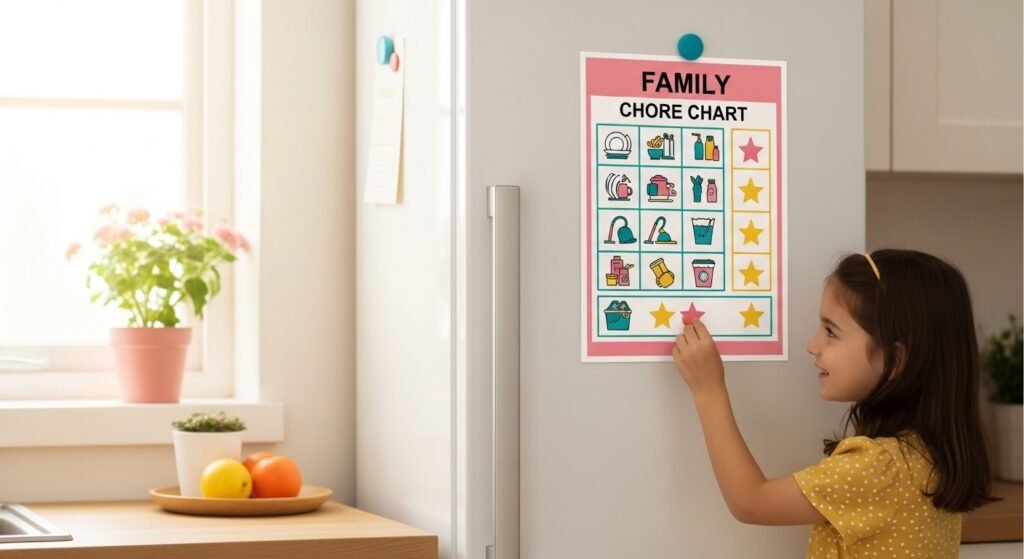
The result is a clear, visual weekly chore chart that everyone in the family can see and follow.
It replaces the sticky notes on the fridge, the forgotten verbal reminders, and the “but I didn’t know it was my turn!” excuses. Everything’s laid out, assigned, and trackable.
How to Use a Family Chore Chart Builder (Step by Step)
Our free tool makes this really simple. Here’s exactly how it works:
Step 1 — Add Your Family Members
Start by adding everyone who’ll have chores — mom, dad, kids, even grandma if she’s living with you. Each person gets a color-coded card with a customizable emoji avatar. You can pick ages too, which helps with the age-appropriate chore suggestions built into the tool.
Step 2 — Browse and Add Chores
The tool comes loaded with over 50 pre-built chores across 7 categories:
- 🍽️ Kitchen — washing dishes, wiping counters, emptying the dishwasher
- 🧹 Cleaning — vacuuming, dusting, mopping, scrubbing the toilet
- 👕 Laundry — sorting, folding, putting away
- 🌿 Outdoor — mowing, raking leaves, watering plants
- 🛏️ Bedroom — making beds, tidying, organizing the closet
- 🐾 Pet Care — feeding, walking, cleaning the litter box
- 🛒 Errands — setting the table, unpacking groceries, helping with cooking
Just tap any suggestion to instantly add it. Or type in your own custom chores.
Step 3 — Assign Tasks and Set Point Values
For each chore, you can assign it to a specific family member and set a point value. Tougher chores get more points — scrubbing the toilet is worth more than making your bed, obviously.
Step 4 — Build Your Weekly Chart
Hit the Build My Chore Chart button and your full 7-day grid appears. You’ll see each chore listed by day with a clickable checkbox for each. As family members complete tasks, they tick them off and their points update in real time.
Step 5 — Set Up Rewards
Head to the Rewards tab to create milestones. 10 points = ice cream. 20 points = 30 minutes of extra screen time. 50 points = a $5 allowance bonus. You decide what motivates your kids.
Step 6 — Print and Post It
Click Print Chart and stick it on the fridge. Done.
Why a Weekly Chore Chart for Kids Actually Works
You might be thinking — do chore charts really make a difference? The short answer is yes, and there’s real logic behind it.
It removes ambiguity
Kids don’t always avoid chores out of laziness. Sometimes they genuinely don’t know what’s expected of them. A printed chart eliminates that confusion completely. There’s no “I forgot” when it’s written on the fridge.
It teaches responsibility early
Research in child development consistently shows that kids who have regular household responsibilities develop stronger work ethics, better time management, and higher self-esteem as they grow up. Starting early — even with simple tasks for toddlers like putting toys away — builds habits that stick.
The points system taps into natural motivation
Kids are wired to respond to progress and rewards. Earning points toward something they want (a movie night, a treat, extra game time) makes chores feel less like punishment and more like a game they’re winning. Parents who use reward-based chore charts report dramatically less pushback on daily tasks.
It distributes household work fairly
This one’s for the adults in the room. A chore chart isn’t just for kids — it helps partners divide household labor more transparently. When everything’s assigned and visible, there’s less resentment and fewer “I always do everything” conversations.
Real-Life Examples of How Families Use It
The Martinez family in Texas has three kids aged 5, 9, and 13. Mom uses the chore chart builder to assign age-appropriate tasks to each child — the 5-year-old puts toys away and feeds the dog, the 9-year-old vacuums and empties the dishwasher, and the 13-year-old handles laundry and mowing. Every Sunday, they tally points and the winner picks Friday’s dinner.
Single dad in Ohio uses it just for himself and his 8-year-old. He sets up the chart on Sunday nights together, and his son genuinely looks forward to checking off his tasks. “He actually reminds me when he’s done something so I can mark it,” he says.
A blended family in Florida with five kids uses the rotation feature to make sure no one always gets stuck with the worst chores. The chart rotates assignments every week automatically.
Tips for Making Your Chore Chart Stick
- Start small. Don’t assign 10 chores at once. Start with 3–4 per person and build from there.
- Let kids choose some chores. Giving children a say in which tasks they take on increases buy-in significantly.
- Keep rewards realistic. The best rewards are things your kids already value — screen time, a favorite meal, staying up 30 minutes later on a Friday.
- Review weekly together. Sit down every Sunday as a family, check the chart, hand out points, and plan the next week. Make it a ritual, not a chore in itself.
- Praise the effort, not just the result. A 6-year-old’s version of “made the bed” won’t be perfect. That’s okay. Acknowledge the effort.
Try Our Free Family Chore Chart Builder
We built a completely free family chore chart builder that works right in your browser — no downloads, no login, nothing to install.
Here’s what makes it stand out:
- 50+ pre-loaded chores across 7 household categories
- Color-coded member cards with customizable emoji avatars
- Live 7-day weekly chart with clickable checkboxes
- Points system that updates in real time as chores are completed
- Rewards tab where you set milestone prizes for your kids
- Age-appropriate chore guide built right in (ages 2–3 all the way to 12+)
- Print-ready layout — one click and it’s fridge-worthy
It takes about 5 minutes to set up and makes a genuine difference in how smoothly your household runs.
Use the Free Family Chore Chart Builder above
Frequently Asked Questions
Q1: What is a family chore chart builder? A family chore chart builder is a free online tool that lets you create a customized weekly chore schedule for your household. You add family members, assign tasks, set point values, and print or display the chart — all without any app or account needed.
Q2: What chores are appropriate for kids by age? Ages 2–3 can put toys away and throw trash in the bin. Ages 4–5 can set the table, feed pets, and water plants. Ages 6–8 can vacuum, wash dishes, and empty the dishwasher. Ages 9–11 can do laundry, rake leaves, and clean the bathroom. Ages 12 and up can handle most adult-level chores including cooking and grocery shopping.
Q3: How do I get my kids to actually follow the chore chart? The most effective approach is combining a visual chart (posted somewhere they see every day, like the fridge) with a points and rewards system. Kids respond much better when they’re working toward something they want. Letting them choose some of their own chores also increases follow-through.
Q4: Can I use this chore chart for adults too? Absolutely. Many couples use chore charts to divide household responsibilities fairly between partners. The chart works for any household member, regardless of age.
Q5: Is the family chore chart builder free? Yes, completely free. No account, no subscription, no credit card. Just open the tool, build your chart, and print it.
Q6: Can I print the chore chart? Yes. The tool includes a print-ready layout — just click the Print Chart button and it formats cleanly for standard letter-size paper, ready to stick on the fridge.
Related Tools You Might Find Useful
1. Kids’ Screen Time Planner Set daily screen time limits for each child by device and day of the week. Balance educational and entertainment screen use with a clear weekly plan.
2. Allowance Tracker & Calculator Track weekly allowance payments tied to chore completion. Set per-chore rates, calculate weekly totals, and keep a running balance for each child.
3. Family Weekly Schedule Builder Plan your entire family’s week — school, activities, work, meals — in one visual calendar everyone can follow.
4. Kids’ Reward Points Chart Create a standalone points tracker for kids separate from chores. Add custom reward milestones and let kids redeem points for prizes you set.
5. Morning Routine Checklist (Kids Version) Build a step-by-step visual morning routine for school days — wake up, brush teeth, get dressed, eat breakfast, pack bag. Reduces the morning chaos significantly.
All tools are free to use. No account required.